Legitimate garage door technicians provide specific paperwork at three points in the job: before work begins, during the visit, and once everything is finished. A company willing to produce every document without hesitation rarely has anything to hide once the actual work starts.
Paperwork left unrequested almost always disappears entirely once a technician has already been paid in full and moved on to the next job. This guide covers exactly what to request before, during, and after a repair, along with what a well-run garage door service should offer as standard practice.
Key Takeaways
- Licensing and insurance paperwork should arrive before any technician touches the door.
- Post-service documents confirm what was actually inspected, repaired, or replaced on-site.
- Warranty paperwork protects a homeowner long after the job is technically finished.
- Reputable companies rarely hesitate when asked to produce any of these documents.
- Missing paperwork at any phase is a signal worth taking seriously before payment.
Core Documents to Request Throughout the Job
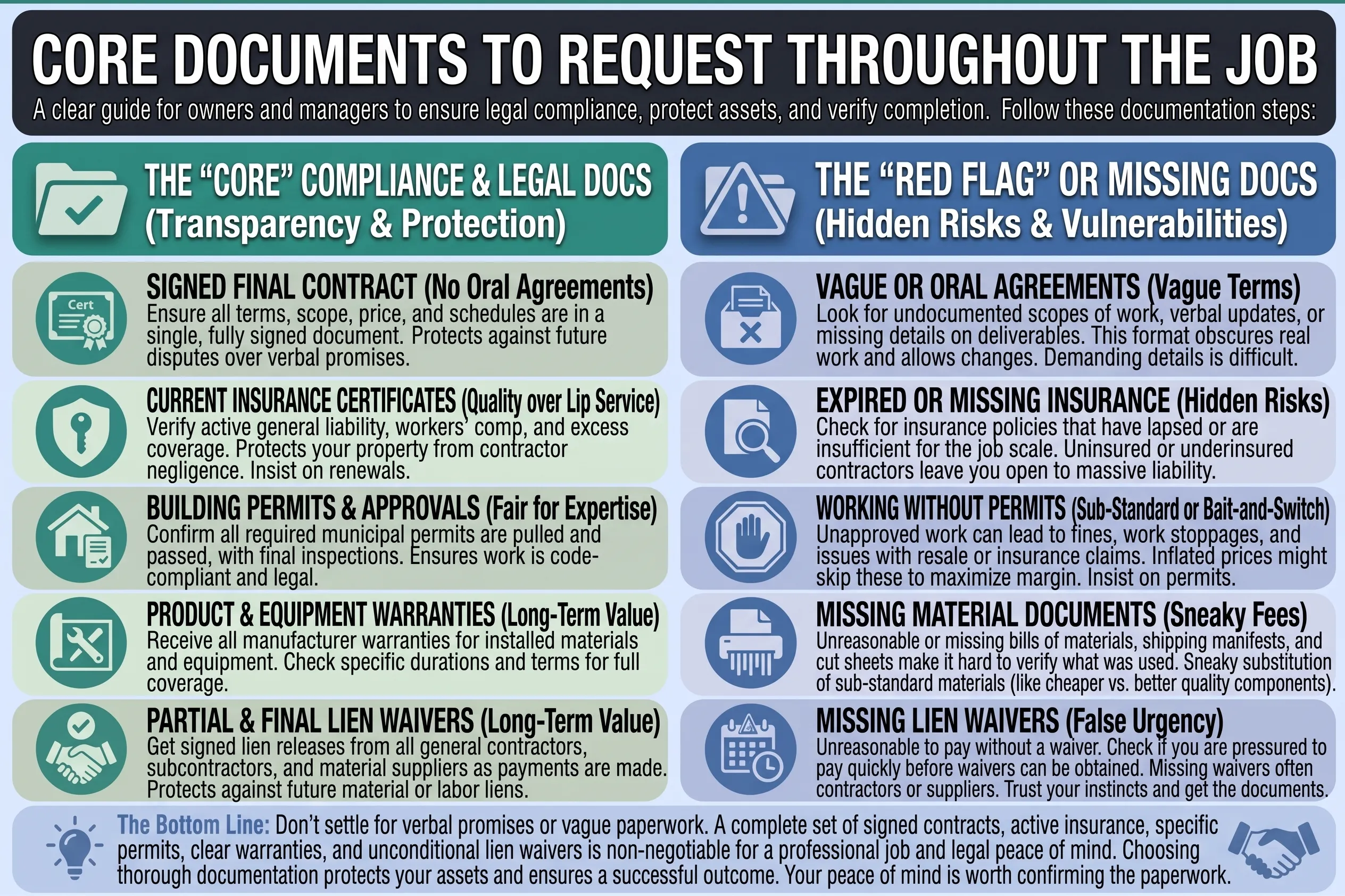
Knowing which documents apply to which specific phase of the job avoids real confusion once paperwork is actually requested on-site.
Document | What It Confirms | What Happens Without It |
Pre-Work Credentials | ||
Liability Insurance Certificate | Covers accidental property damage during the job | Damage costs fall entirely on the homeowner |
Workers Compensation Proof | Covers injury to a technician on the property | Injury liability shifts to the homeowner |
State Contractor License | Confirms legal standing to perform the work | No legal recourse if the job goes wrong |
Written Estimate | Locks in pricing before any work begins | Pricing can shift once work is underway |
Signed Service Contract | Documents scope, timeline, and payment terms | Scope disputes have no written resolution |
Post-Service Verification | ||
Itemized Final Invoice | Confirms exactly what was completed and charged | No proof of what was actually paid for |
Component Inspection Log | Records the condition of springs, cables, and tracks | No baseline for tracking future wear |
Safety Reversal Test Documentation | Confirms opener safety features function correctly | No proof the opener meets safety standards |
Door Balance and Weight Report | Confirms spring sizing matched the door weight | Incorrect springs may go undetected |
Long-Term Record Handover | ||
Workmanship or Labor Warranty | States coverage length on installation or repair labor | No recourse if the same issue returns |
Manufacturer Product Warranty | Covers panels, finish, springs, or opener hardware | Replacement parts may not be covered |
Recommended Maintenance Schedule | Keeps the warranty active through routine upkeep | Warranty coverage may lapse unnoticed |
Missing paperwork at any single phase leaves a real gap in the protection the other two phases were specifically designed to provide together.
Phase 1: Pre-Work Credentials and Agreements
Pre-work documentation confirms a technician carries real legal standing before a single tool comes out of the truck.
Request these documents before scheduling:
- Proof of General Liability Insurance Certificate: Protects the homeowner from financial liability if the technician accidentally damages the property during a garage door installation or repair.
- Proof of Workers’ Compensation Insurance: Ensures the homeowner is not held financially responsible if a technician is injured while on the property.
- Valid State Contractor License: A copy or a clearly written, verifiable license number matching Missouri’s regulatory standards.
- Detailed Written Estimate: A line-by-line breakdown outlining parts, labor charges, trip fees, disposal fees, and taxes so no surprise costs appear later.
- Signed Service Contract: A binding agreement detailing the agreed scope of work, project timeline, payment terms, and any specific promises made.
- Technical Drawings or Manufacturer Specifications: Documents required to file for a local building or code compliance permit when replacing the entire door structure.
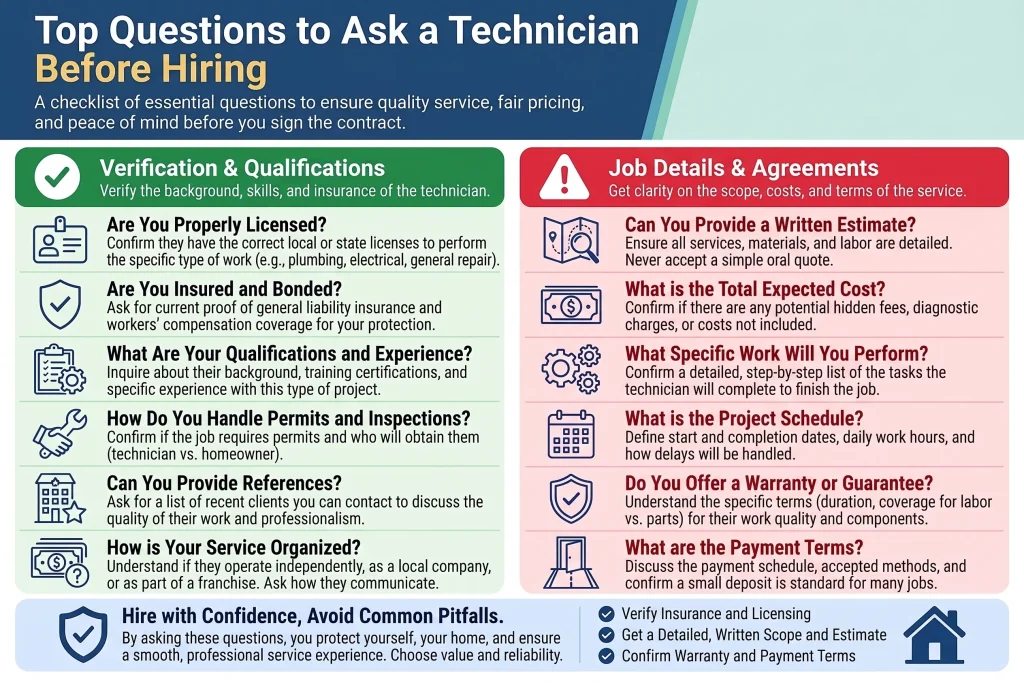
To confirm a technician has the legal standing these documents suggest, read our guide on How to Confirm a Garage Door Technician’s Credentials, which covers the exact verification steps to take before any paperwork changes hands.
Phase 2: Post-Service Verification
Post-service documentation confirms which garage door issues the technician found and fixed while on-site.
Verify these records once the visit is complete:
- Itemized Final Invoice: Proof of payment displaying exactly what work was approved, completed, and paid for.
- Component Inspection Log: A diagnostic sheet detailing the condition of the garage door springs, rollers, cables, tracks, and opener motor.
- Safety Reversal Test Documentation: Written or digital certification proving that the automatic opener’s photo-eye sensors and mechanical reversal tests function according to legal safety standards.
- Door Balance and Weight Report: Verification that a manual balance check was performed and that spring sizing matched the exact door weight.
- List of Replaced Parts With Serial Numbers: A formal record of the exact part numbers used, critical for validating part-specific manufacturer warranties.
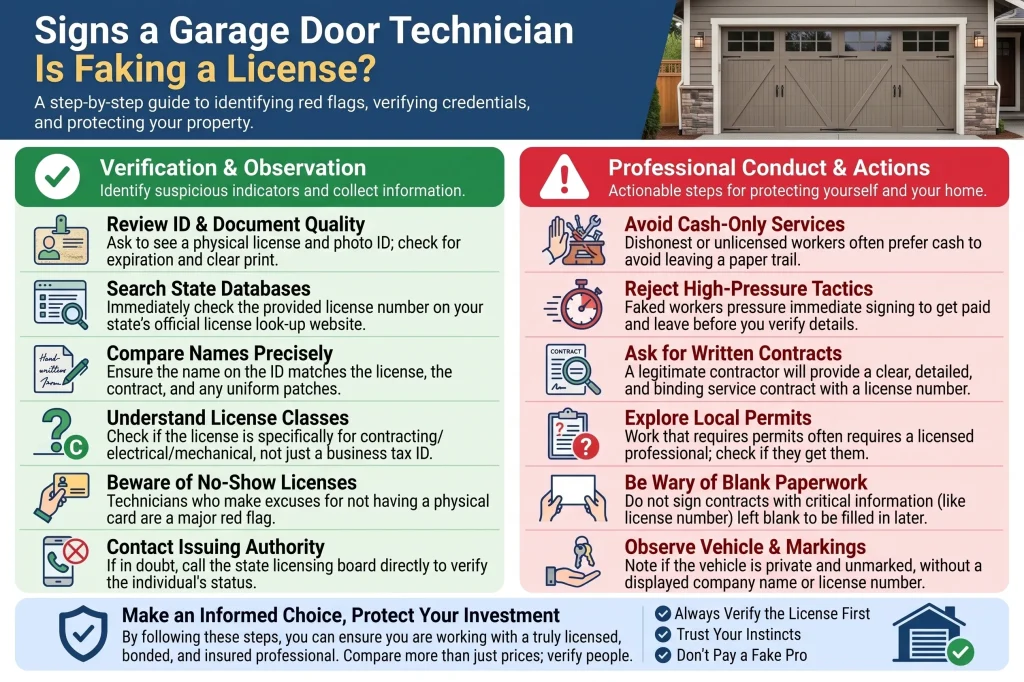
To recognize the warning signs of a technician who avoids documentation, read our guide on Signs a Garage Door Technician Is Faking a License, which walks through the behaviors that reveal a fake license before any money changes hands.
Phase 3: Long-Term Record Handover
Long-term records matter most once the technician has left and the job is fully finished and paid.
Collect these documents before considering the job complete:
- Workmanship or Labor Warranty: A written document specifying exactly how long the company guarantees its installation or emergency garage door repair labor against errors.
- Manufacturer Product Warranty: Official certificates or registrations for the new door panels, finish, springs, or electronic opener hardware.
- Owner Operations and Maintenance Manual: Physical or digital instructional guides for operating the system and using the emergency manual release cord.
- Recommended Maintenance Schedule: A formal log outlining routine check-ups needed to prevent premature component failure and keep the warranty active.
To raise these long-term documentation questions before a technician arrives, read our guide on Questions to Ask Before Hiring a Garage Door Technician, which covers exactly what to ask and how to interpret the answers.
What Happens After the Paperwork Is in Hand
Complete paperwork does far more than sit forgotten in a drawer once the job is finished and the technician has already left.
Put this documentation to use in these ways:
- File every warranty document by date in case a repair issue resurfaces.
- Reference the component inspection log during any future service call.
- Keep the recommended maintenance schedule visible for any technician on-site later.
- Share manufacturer specifications with future technicians working on the same system.
- Store manufacturer warranty registrations in one place for easy future access.
Confirming these overcharging red flags never appear on a final invoice gives a homeowner one last layer of protection before calling the job complete.
A Technician Without Paperwork Has Nothing to Stand On
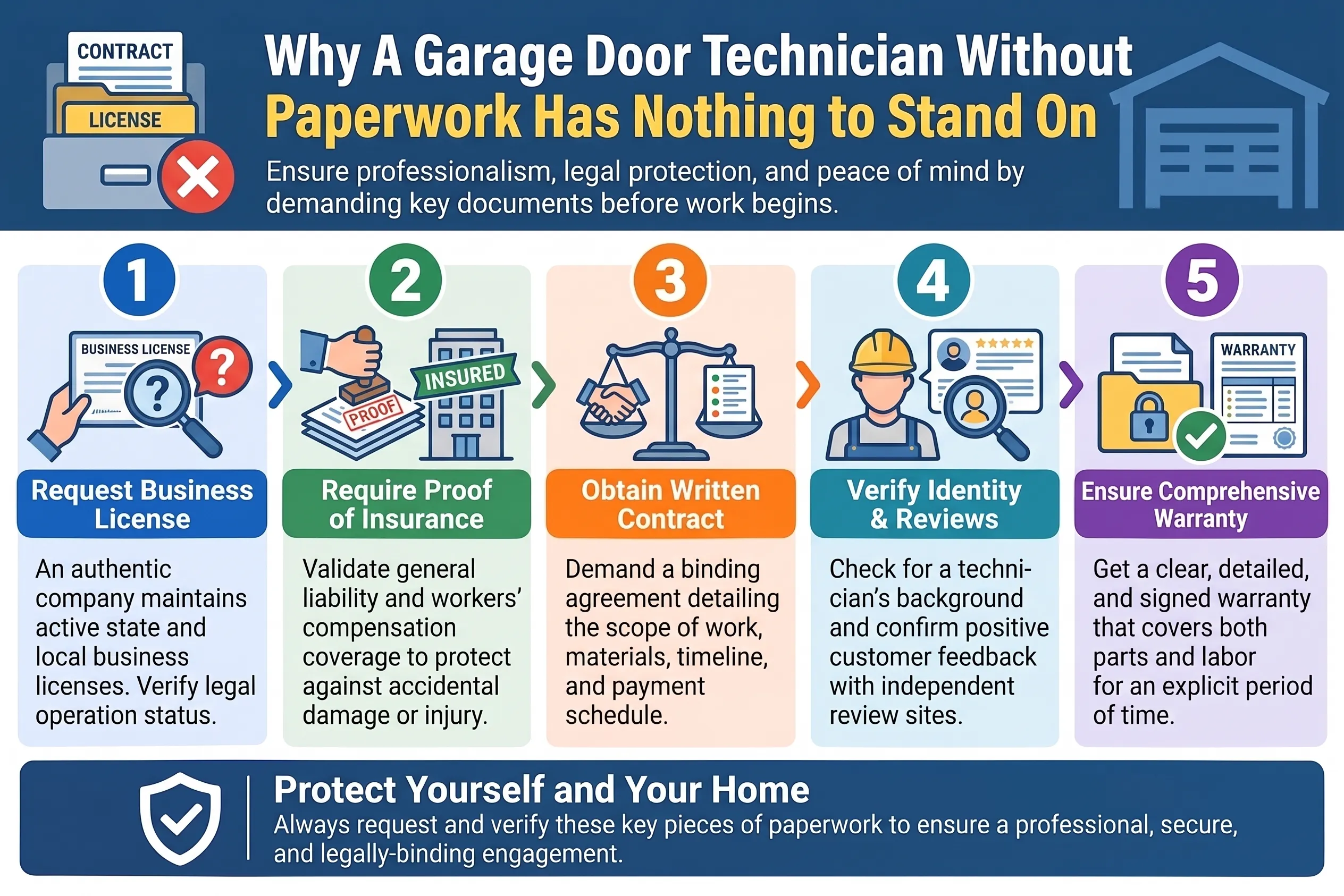
A technician’s word means little compared with the paperwork trail left behind once the job is finished and paid for. Licensing proof, inspection logs, and warranty documents together confirm the work was done honestly and correctly, giving homeowners real peace of mind.
Anytime Garage Doors backs every appointment with the full paper trail Kansas City homeowners need, from licensing proof before the job starts to warranty documents once it ends. Contact us or give us a call today to schedule service with a local team that hands over every document without being asked twice.