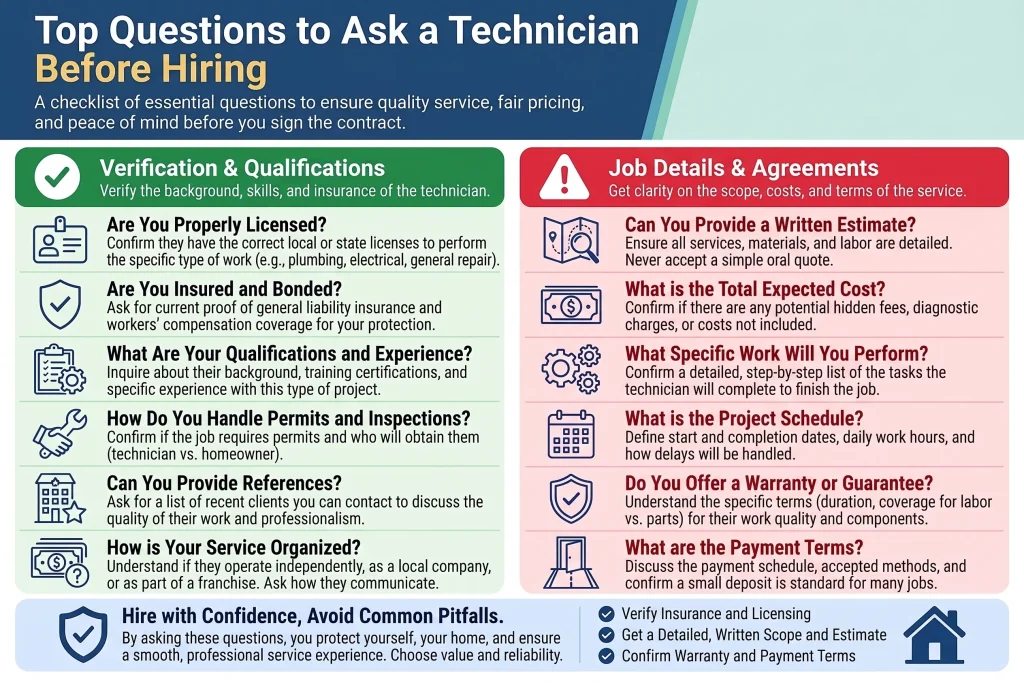
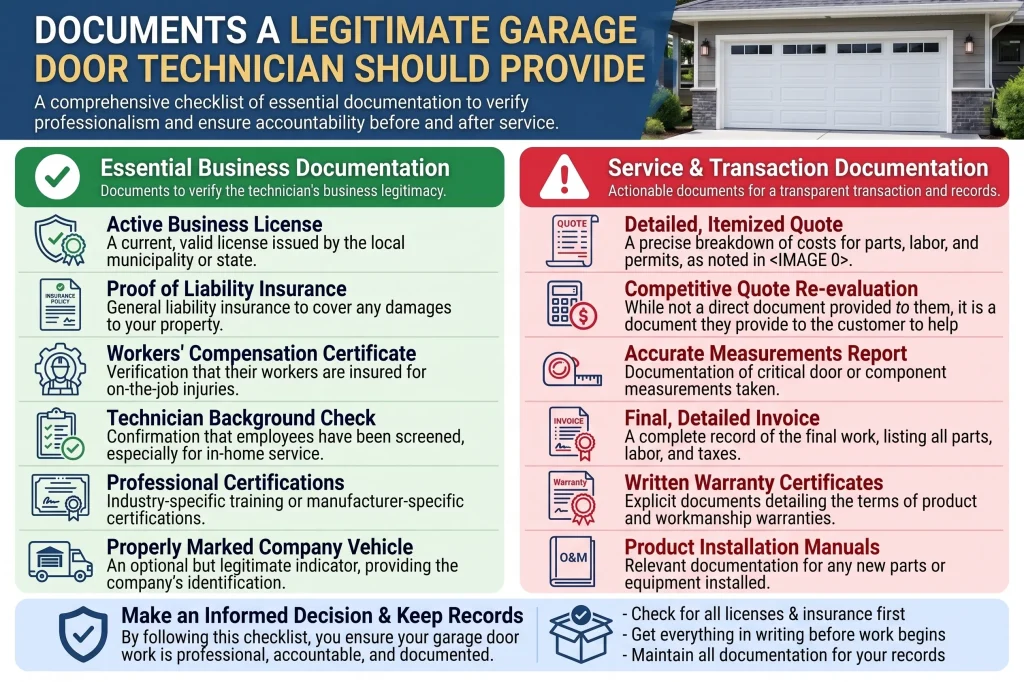
Faked licenses rarely hold up once a homeowner checks even one detail independently, whether that means calling the state database or asking a direct question in person. Operators counting on nobody checking tend to fall apart quickly once a garage door service call moves past small talk.
Recognizing these patterns early on saves a homeowner real money by avoiding work that was never properly licensed in the first place, sometimes by a wide margin. This guide walks through the specific behaviors that reveal a fabricated license in detail, plus exactly what to do once several signs line up.
Key Takeaways
- License numbers that return no match in the state database are a serious warning sign.
- Legitimate technicians rarely hesitate to show physical identification when asked directly.
- Business names that shift between the invoice, jacket, and phone call are suspicious.
- Vague company names often exist specifically to dodge bad reviews and complaints.
- Missing or fake physical addresses usually mean there is nothing to inspect.
Warning Signs a License Might Be Fake
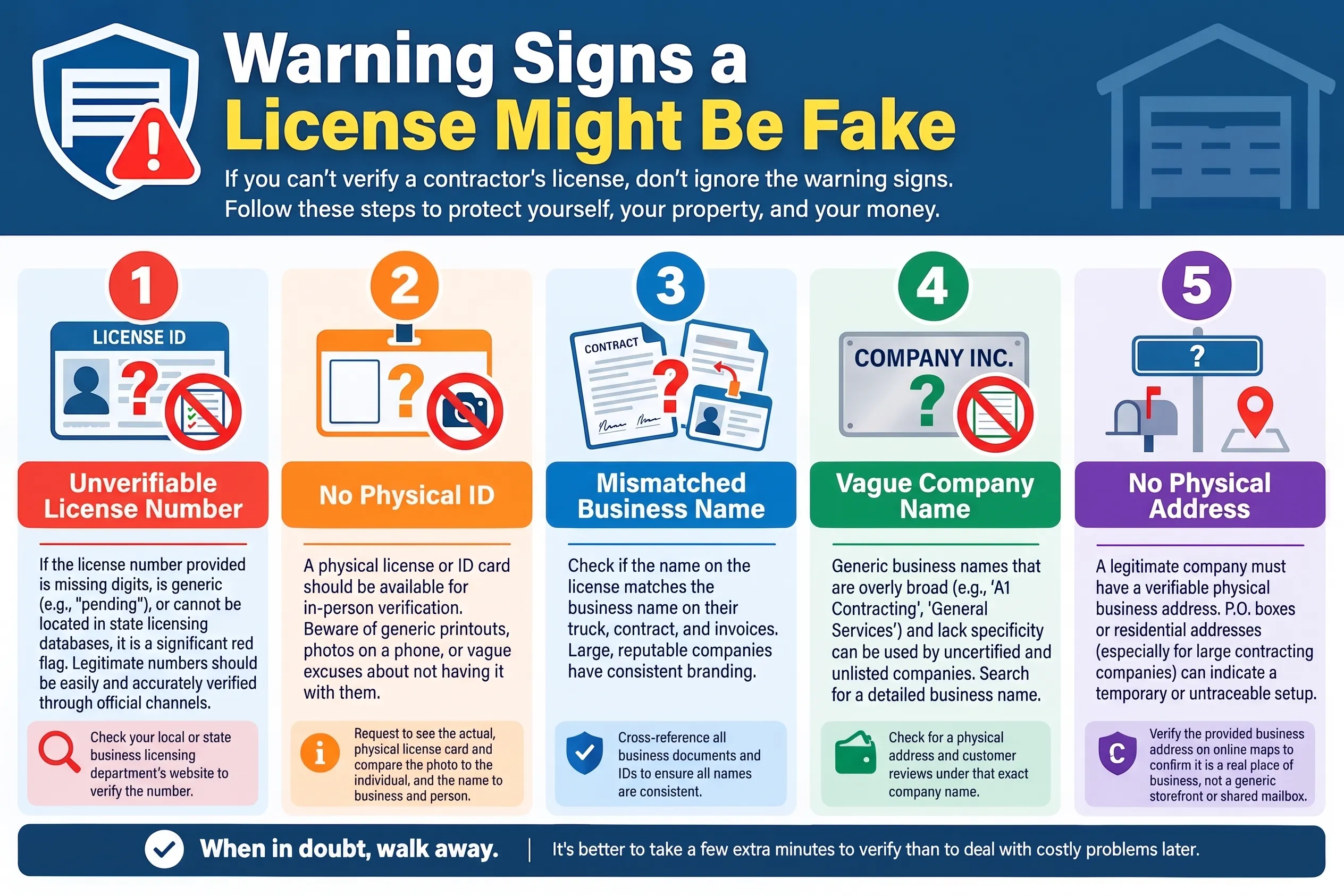
Fake licenses tend to fail in a handful of predictable ways once someone actually takes the time to look closely at the details.
|
Warning Sign |
What It Looks Like |
What It Usually Means |
|
Unverifiable License Number |
Number returns no match in the state database |
The license does not legally exist |
|
No Physical ID |
Excuses about a badge left at the office |
Identity cannot be confirmed on-site |
|
Mismatched Business Name |
Name on invoice differs from the name called |
Company identity is being obscured |
|
Vague Company Name |
Generic title with no registered brand |
Name rotates to avoid bad reviews |
|
No Physical Address |
P.O. box or vacant lot listed as an office |
No accountable business location exists |
A single failed check almost always confirms a pattern once a homeowner compares it with a technician’s other claims and on-site behavior.
Unverifiable License Number
License numbers that don’t appear anywhere in the state database rank among the clearest signs something is genuinely wrong.
Confirm these details before trusting any license number given:
- Search the number directly through the state contractor licensing database.
- Confirm the license category actually covers garage door work.
- Check whether the license status shows active or expired.
- Verify the name attached to the license matches the company name.
- Note any mismatch between the number provided and the paperwork.
To confirm a license holds up under real scrutiny, read our guide on How to Confirm a Garage Door Technician’s Credentials, which covers the exact verification steps to take before any work begins.
Excuses for No Physical ID
Technicians who cannot produce identification often have a plausible-sounding reason that rarely holds up under questioning.
Watch for these excuses when identification is requested:
- Claiming a badge or ID card was left at the office.
- Offering a business card instead of actual identification.
- Promising to email a copy of credentials later.
- Deflecting the question entirely by changing the subject.
- Getting irritated or defensive when you repeat the request.
Insisting on identification before any garage door installation begins rarely leaves a homeowner regretting the extra minute it takes.
Mismatched Business Names
Names that shift between the phone call, invoice, and jacket signal something worth questioning, especially before an emergency garage door repair visit.
Compare these details across every point of contact:
- Company name used during the original phone call or booking.
- Name printed on the technician’s jacket or uniform.
- Name listed on the written estimate or invoice.
- Name tied to the license number provided.
- Name appearing on any online reviews or listings found.
To confirm which paperwork should stay consistent across every point of contact, read our guide on Documents a Legitimate Garage Door Technician Should Provide, which breaks down exactly what a homeowner should request before any work begins.
Vague or Shell Company Names
Generic names dodge accountability entirely, a pattern closely tied to known scam patterns seen across the industry today.
Look for these patterns in a company’s naming and branding:
- A name like “Garage Door Services” with no distinct brand identity.
- Multiple similar business names traced back to the same phone number.
- No consistent name used across the website, invoice, and vehicle.
- Names that changed recently according to online business records.
- No trademark or registered business filing tied to the name.
Shell names built to disappear after complaints pile up rarely survive contact with a homeowner willing to search for a garage door repair history under that name.
No Physical Address
Missing or fake business addresses mean there is no accountable location to return to later if the job goes seriously wrong.
Confirm these details about any listed business address:
- Address searched on a map to confirm an actual office exists.
- Listing checked against a P.O. box or mail drop service.
- Years of operation confirmed at the address currently listed.
- Local phone number verified independently, not taken at face value.
- Address cross-checked against county business filing records.
To ask this exact question before scheduling any technician for the job, read our guide on Questions to Ask a Technician Before Hiring, which covers exactly what to ask and how to properly interpret the answers given.
How to Report a Technician Faking a License
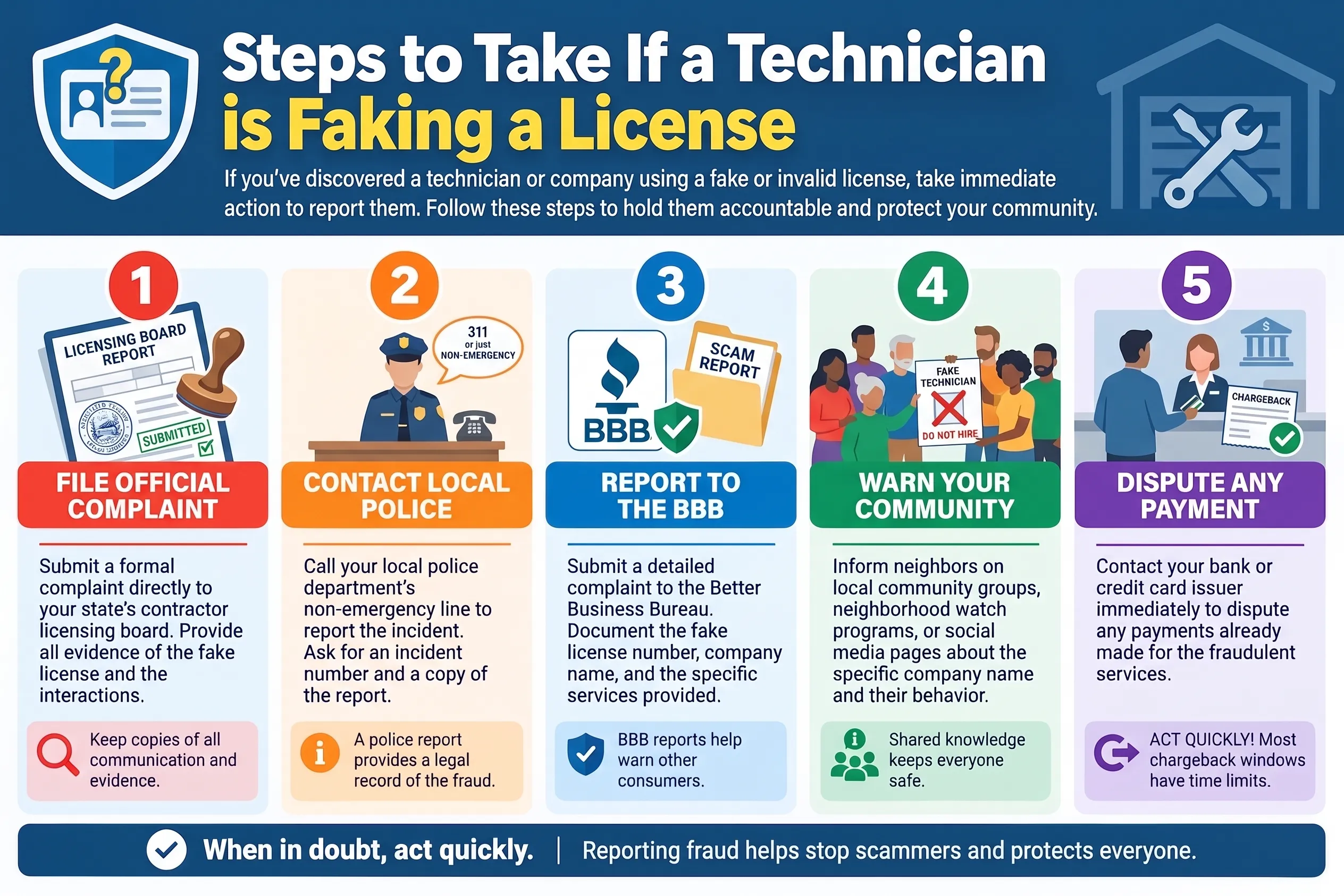
Report fake licenses quickly to protect nearby homeowners and create a clear, dated record if the situation escalates.
Take these steps once a fake license is confirmed:
- File a report directly with the state contractor licensing board.
- Report the incident to the local police non-emergency line.
- Submit a complaint to the Better Business Bureau with documentation.
- Warn neighbors or local community groups about the specific company name.
- Dispute any payment already made through the bank or card issuer.
Filing this report alongside proof of inflated repair estimates gives investigators a clearer picture of the overall pattern.
Basic Scrutiny Exposes Every Fake License
Technicians relying on a fake license depend on a homeowner never checking, which is why one verification step often ends the conversation quickly. Consistent names, a real address, and a license that matches state records form the baseline for legitimate work, not extra steps beyond it.
Anytime Garage Doors gives Kansas City homeowners a team whose license, name, and business address hold up to this kind of scrutiny every time. Contact us or give us a call today to schedule service with technicians who have absolutely nothing to hide from any homeowner asking.